



Adding a low-maintenance, long-lasting composite deck is an excellent way to improve your outdoor space. And if you’re comfortable with basic carpentry and have a solid plan, installing composite decking can be a great DIY project.
While the process is relatively straightforward, achieving a high-quality, professional-looking result depends on careful layout, proper spacing, and the right tools and fasteners. In this guide, you’ll learn what to consider before you start, along with step-by-step instructions and pro tips to help you install composite decking the right way. (And for help designing your new favorite outdoor space, check out these plans or try this free deck design tool.)
What to Consider Before You Build a Composite Deck
Before you start ordering materials or digging footings, it’s important to think through a few key decisions. The size, location, and structure of your deck will affect everything from cost and comfort to code compliance and long-term performance. The sections below will help you get the big-picture items dialed in before you move on to the actual installation.
Get permission before you plan
Before finalizing your design, make sure you understand the local requirements for building a deck. Most municipalities require a building permit, and there are typically rules around setbacks, height limits, and overall deck size.
If your deck will be attached to the house or elevated, inspections are almost always required. If you live in a neighborhood with a homeowner’s association (HOA), you may also need approval for the deck’s size, height, color, and materials before you begin.
Determine the best size for your deck
The average deck in the United States is roughly 300 to 400 square feet, but the “right” size for you depends entirely on how it will be used. If you have a smaller home or simply want a quiet outdoor retreat, a compact deck in the 100- to 200-square-foot range can be perfect for a couple of chairs and a small table. On the other hand, if you have a larger home and enjoy hosting family and friends, you may want a deck in the 400- to 600-plus-square-foot range to comfortably accommodate dining areas, seating, and traffic flow.
It’s also important to plan your deck size around the materials you’ll be using. Most composite deck boards are 12, 16, or 20 feet long, and standard railing sections are often designed in 6- or 8-foot spans. Designing your layout to work with these dimensions can help minimize waste and reduce costs.
Find the best place to build a deck
Start by thinking about how the space will feel throughout the day. A deck that gets full afternoon sun may be ideal in cooler climates, but in hotter regions like Texas, taking advantage of natural shade from trees can make the space far more usable.
Wind exposure is another key factor. A deck on a home in the open plains of Kansas may benefit from windbreaks or placement on the leeward side of the house, while a location that captures a steady breeze can be an advantage in hotter, drier regions.
Convenience also matters. A deck located just outside the kitchen makes grilling and entertaining easier, while a more secluded deck farther from the house can create a quiet, private retreat. Many homeowners balance these priorities by incorporating multiple levels or a wraparound design.
Decide what style of borders and fascia you want
One popular option is a picture frame border, in which a perimeter board runs around the deck. This creates a clean, finished look and helps hide cut ends of the field boards. However, picture framing requires careful planning and additional blocking.
You’ll also need to decide how the decking and fascia will meet. Some builders prefer to have the fascia board sit flush with the top of the decking, while others let the decking overhang the fascia for a more traditional look.
For longer decks, especially those over 20 feet, you may also need to incorporate a divider board down the middle. This allows you to break the deck into two or more runs, reduces the need for staggered seams, and can help manage expansion and contraction. Divider boards also require additional framing.
Consider basic deck footing and framing requirements
A sturdy deck frame starts with properly sized and spaced footings, which will depend on your local soil conditions and climate. Less stable soil requires wider footings, and colder climates require deeper ones. Read this article about how to build footings to learn more.
All the framing lumber must be pressure treated to resist rot and insect infestation. Proper sizing and spacing of the posts, beams, and joists will depend on the weight and span of your deck.
In many cases, composite decking manufacturers recommend joist spacing of 16 inches on center, though some products require 12 inches on center. Read this article to learn more about joist spacing.
You’ll also need to use code-approved structural hardware, including connectors and fasteners designed for treated lumber. If your deck is attached to the house, the ledger board connection must be properly flashed and installed to prevent water intrusion and ensure a safe, long-term connection. For more framing instructions, check out Trex Academy to get step-by-step details.
Pro Tip: Protect the top of the joists
Adding a protective, self-adhering membrane to the top of the joists and blocking can add years to the structure of your deck.
Leave room for expansion and contraction
Composite decking expands and contracts as temperatures change, so it’s important to leave proper gaps during installation. Without adequate spacing, boards can push against each other in hot weather, which may lead to buckling or a wavy surface.
You’ll need to leave a small gap at the ends of each board where they meet another board or a fixed object like a picture frame border, fascia, or post. In most cases, this gap is about 1/8 inch to 1/4 inch, depending on the product and the temperature at the time of installation. Hidden fastener systems will typically handle spacing between the sides of boards, but end-to-end gaps must be planned carefully.
Because expansion rates vary by manufacturer, always check the specific guidelines for the product you’re using. It’s also best to install composite decking on a moderate temperature day whenever possible. Installing in extreme heat or cold can make it harder to achieve consistent spacing once the boards adjust to normal conditions.
How to Install Composite Decking
With your footings installed and the frame built, it’s time to start installing your composite decking. The steps below will guide you through the process and help ensure you achieve a beautiful and long-lasting finished surface.
Step 1: Gather tools and materials
Gathering all the tools and materials you need before you make that first cut will save time by preventing unnecessary trips to the supplier and tool shed.
Tools
- Sawhorses
- Pencil and marker
- Tape measure
- Drill/driver with bits
- Circular saw and/or miter saw
- Jigsaw
- Speed square
- Bar clamps
- Chalk line and/or string
- Rubber mallet
Materials
- Grooved composite decking
- Solid composite decking for picture frame and stairs
- Fascia boards
- Joist flashing tape
- Hidden deck clip fasteners
- Surface deck fasteners: Screws, and/or screws & plugs for first and last deck boards and for picture frame and step boards
- Fascia fasteners
- Trex® Universal Fastener Installation Tool (optional)
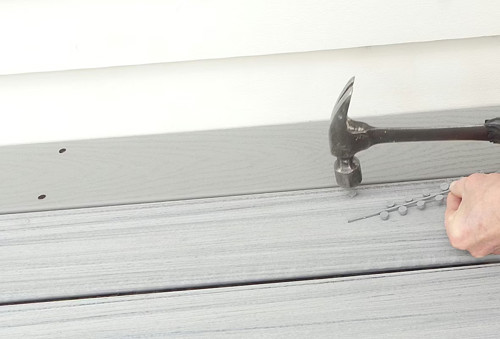
Pro Tip: Hide screw heads with plugs
Deck plugs are a great option when you need to secure a board through the top surface with screws. The plugs are made from the exact same material as the decking itself, so they become almost invisible.
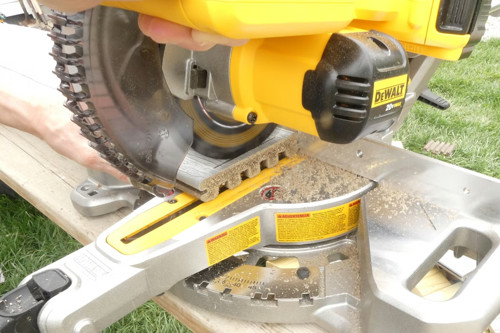
Step 2: Trim one end of the boards
The ends of a new deck board aren’t always cut cleanly or square. If your deck plan doesn’t involve trimming the ends of each board after they are installed, trim about 1/2 inch off one end of the board and then measure to length from that side.
Step 3: Install the outside board first
If you start installing deck boards near the house and work your way to the end of the deck, you will likely have to rip that last board down to fit. If all your deck boards are 5 1/2 inches wide, except for the last board, which has been ripped down to 3 inches, that board will stand out. To avoid this, start installing the deck boards (this could be the picture frame board) at the outside edge and work your way back toward the house. (A partial board near the house isn't nearly as noticeable.)
You can try to plan ahead by calculating how many full boards will fit and sizing the deck accordingly, but this requires very precise spacing. Small errors add up. For example, on a 12-foot-wide deck, if each gap is just 1/32 inch too large, your last board will be 3/4 inch too large. Either way, you do want to try to build the deck so that the last board is at least half the width of a full board or larger.
If you are using hidden fasteners and are not installing a picture frame board, use the clips specifically designed for the outside edge of the first board. These clips are included when you buy Trex Hideaway® Clips hidden fasteners. See Step 4 to learn more about how to use both composite deck screws and hidden fasteners.
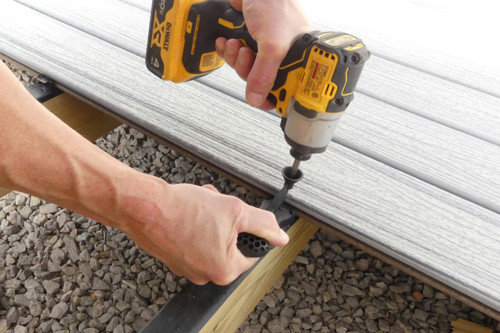
Step 4: Install the middle boards
Using Screws:
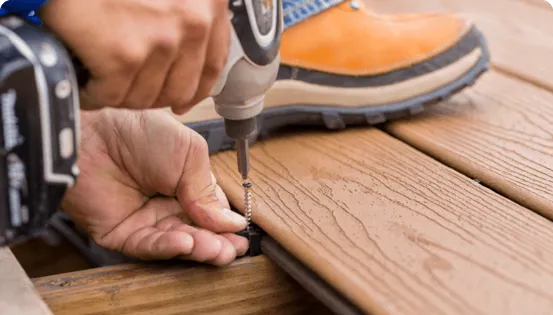
Use two fasteners at each joist location, placed about one inch in from each edge of the board. Standard wood deck screws can cause composite decking to mushroom and distort, so only use screws designed specifically for composite decking. Be sure to maintain the manufacturer’s recommended gap between boards. If the composite deck screws are difficult to drive or are still distorting the surface, predrill holes using a 1/8 inch drill bit.
Using Trex Hidden Fasteners:
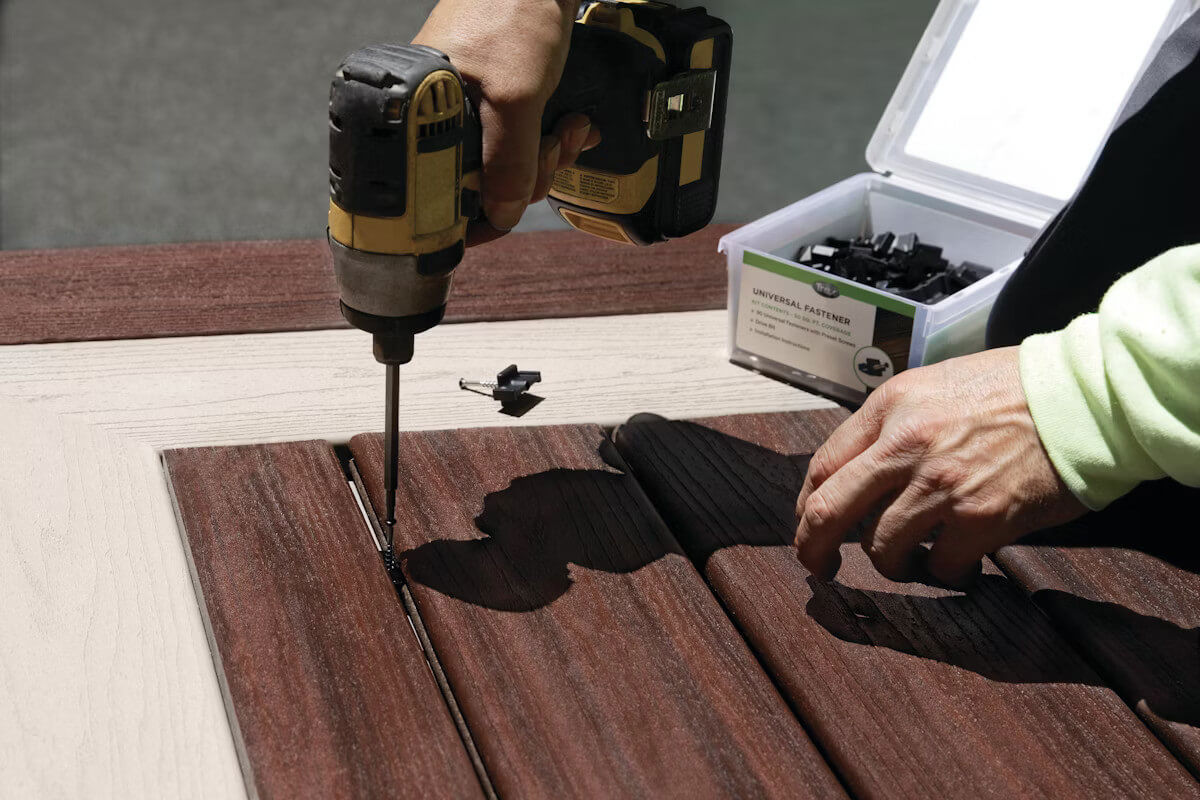
After the groove of the first board is securely engaged with the starter clips, install one clip at each joist along the exposed edge of the board. For all remaining boards, install clips on both sides.
To install the clips, insert them into the exposed groove and drive the stainless steel screw into the joist using the provided bit, but do not fully tighten the clips right away. Instead, follow this sequence:
- Push the board onto the partially fastened clips.
- Insert clips into the groove on the other side of the board.
- Partially fasten those clips.
- Go back and fully tighten the clips from the previous row.
- Repeat this process for each row.
If you are using a Trex hidden fastener tool, you can fully tighten the clips during initial installation.
Pro Tip: Measure and straighten as you go
Every few rows, use a string line or chalk line to check that the boards are straight. Also measure back toward the house to confirm that the last board will be the same width along the length of the entire board.
Step 5: Rip down and install the last board
Measure the distance between the house and the last row, then rip down and install the last board. You will have to use surface/face screws to secure this last row, because there will likely be no groove to insert a clip or the space to fasten it.
Even if you have left one or both ends of the boards long, cut this last board to length before installing it. Because the board is tight up against the wall, it will be harder to cut to size with a saw, and it can serve as a cut guide to mark the rest of the boards.
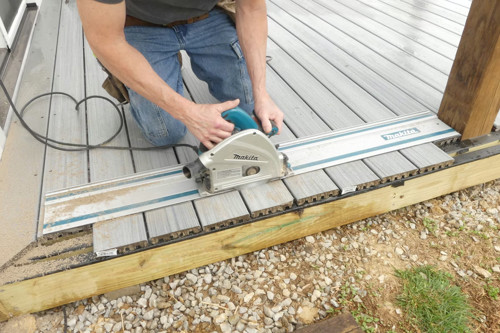
Step 6: Trim off the ends
A track saw is the ideal way to precisely trim the ends of the boards to length. If you don’t have a track saw, snap a line as a guide and use a standard circular saw. You could also clamp down a perfectly straight board as a guide for your saw to run up against. Whichever method you use, take your time. This is a crucial detail because a crooked cut will be noticeable.
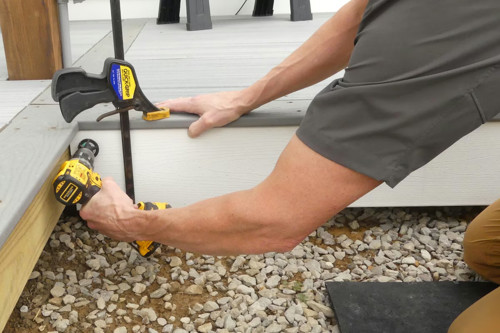
Step 7: Install the fascia
Cover up the sides of the joists with fascia boards. Because fascia boards are wider and thinner than deck boards, they’re more prone to problems due to expansion. That’s why it’s important to use the manufacturer’s recommended fasteners and follow their spacing guidelines. Read this article to learn more about installing deck fascia.
Everything You Need for Trex Composite Decking Installation
Though this guide covers all the essential steps of how to install composite decking, there are always more tips and tricks to uncover. Check out Trex Academy to learn how to build your deck step by step, or start your contractor search by finding a builder near you.
Still looking for a little guidance before you start constructing your own composite deck? Check out these other handy resources to make sure you’re covering all your bases — before installing those deck boards.